
Summary
The exterior option that passes the Amanah without special approval is raised letters with concealed lighting on the building's own facade finish; cladding is a fascia the letters mount onto, not a sign in itself, and an acrylic-face lightbox mostly belongs inside malls or in a design the Amanah approves.
From there the choice is about location and facade condition: the table below compares the options on look, lighting and durability in Jeddah's climate, and the sections that follow set out when each one fits.
What each option actually is
The market mixes these words up because they name two different layers of the storefront: the fascia that covers the facade wall, and the element that carries the shop's name. Telling them apart is half the decision.
- Cladding: aluminium composite panels (ACP) that skin the facade wall and give it a flat surface in stable colours. It is an architectural finish the letters are fixed onto, not a sign in itself.
- Acrylic: a material that spreads light evenly, used as the face of lightboxes and of lit letters, available in UV-stable grades that do not yellow in the sun.
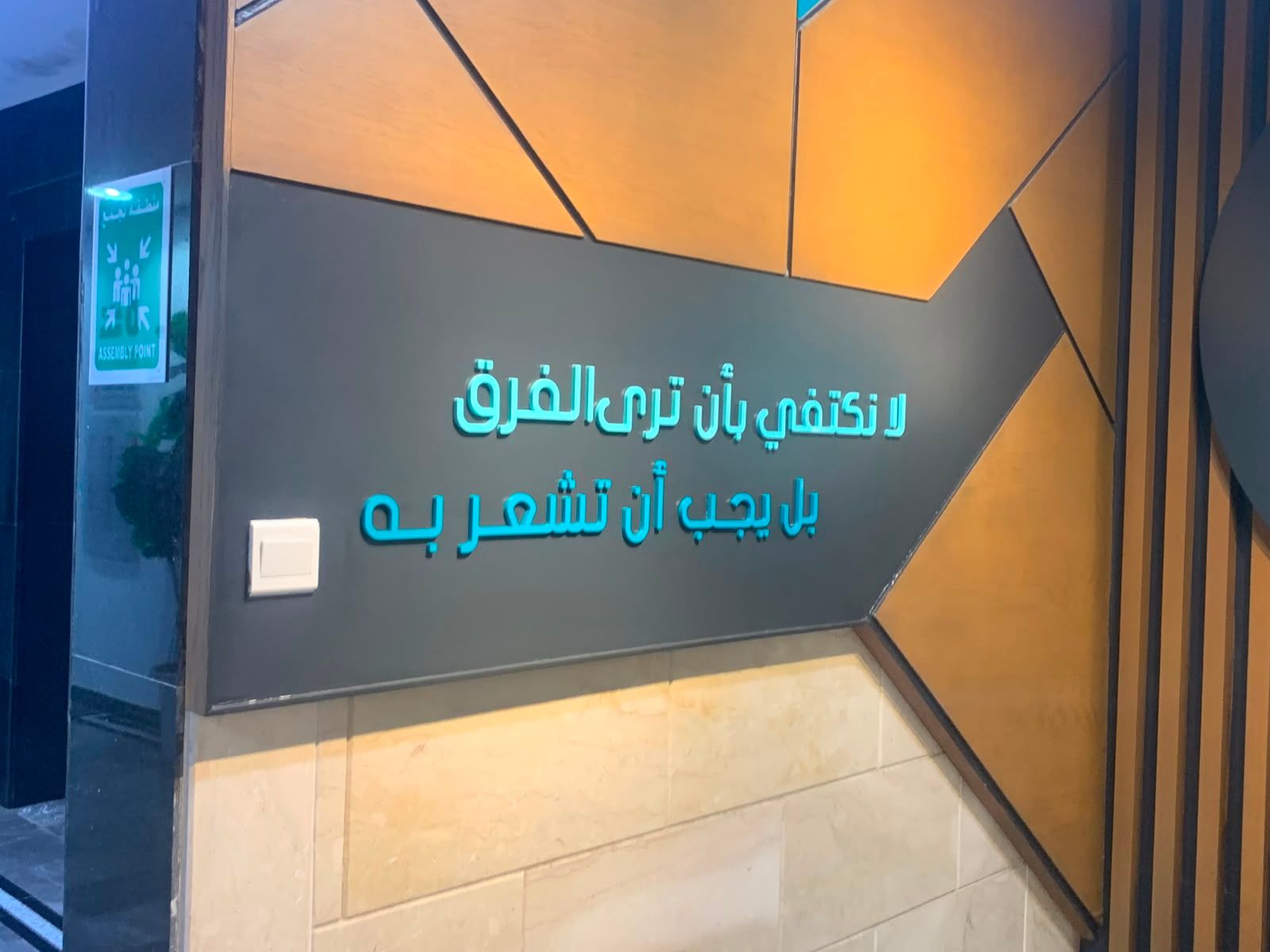
- Raised (3D built-up) letters: hollow letters cut and assembled from acrylic, stainless steel or zincor, face-lit, halo-lit or unlit, fixed directly onto the facade finish.
- Cement board: compressed cement sheets painted in the facade colour, a quieter architectural fascia option, with separate lit letters mounted on top.
The options side by side
The table sums up the practical differences between the four options; the climate and regulatory detail follows in the next two sections.
| Option | The look | Lighting | Durability in Jeddah's climate | Best for |
|---|---|---|---|---|
| Raised letters on the building finish | Depth and shadow, reads day and night | Face-lit or halo, concealed LED modules | Excellent with UV-stable acrylic and drain holes | Street shops, the compliant default |
| ACP cladding fascia with raised letters | A flat, stable-colour surface that renews the whole facade | Letters on top, face-lit or halo | Good with an FR core outdoors, cleaned regularly of dust and salt | Facades that need a new finish, showrooms and warehouses |
| Acrylic-face lightbox | One even, lit face in the brand colours | Even LED backlighting | Good indoors; outdoors it needs sealing and venting | Inside malls and corridors, or an Amanah-approved design |
| Painted cement board fascia | A painted, quiet architectural surface | Separate lit letters mounted on it | Heat-stable, needs exterior moisture-resistant paint | Cafes, small shops and quiet frontages |
How each performs in Jeddah's climate
Jeddah's climate tests a sign four ways: summer heat that peaks above 40 degrees, summer humidity of 53 to 59 percent, dust storms in summer and sometimes winter, and the general salt in Red Sea coastal air. The right material here is not a luxury; it is the sign's lifespan.
- Acrylic: UV-stable grades keep the colour from yellowing, and drain holes at the bottom of the letters stop humidity collecting inside.
- Cladding: an FR (fire-resistant) core for exterior use, PE core indoors only, with regular cleaning because dust and salt dull the colour.
- Cement board: dimensionally stable in heat, and it lives as long as its exterior moisture-resistant paint.
- Metals: near the corniche we use 316 stainless or coated 304 against coastal salt, insulated so different metals do not corrode each other. Zincor is an economical option for large letters and needs a good coating and a check after the humid season.
- Lighting: IP67 LED modules inside the letters and IP65 drivers outside them, with a night check after installation and after dust storms.
What the Amanah requirements allow
The Ministry of Municipalities and Housing requirements make the default exterior shop sign raised letters with concealed lighting on the building's own finish materials; they prohibit floodlights and added backgrounds, and the guide's wrong-examples page shows added cladding backgrounds and box signs as violations.
In practice: cladding is compliant when it is the facade finish itself with the letters mounted on it, or when the Amanah approves it in a submitted design. The box lightbox stays indoors and in malls, and in Jeddah the Amanah's commercial buildings guide prohibits box signs for complex names.
The sign band dimensions, side clearances and permitted content are set out in our guide to the shop-sign licence on Balady, so we do not repeat them here. The point is that choosing the material and choosing what the licensing side accepts are one decision, not two.
How to choose by shop type
- A shop on a commercial street: lit raised letters on the facade finish, the option that passes the Amanah without special approval.
- A unit inside a mall: the mall management's criteria govern, and the common answer is an acrylic-face lightbox on the corridor frontage.
- A showroom or warehouse with a tired facade: an FR-core cladding fascia renews the whole finish with raised letters on top; it costs more than letters alone because it covers the entire facade.
- A cafe or small shop with a quiet character: painted cement board in the brand colour with separate lit letters.
- A site near the corniche or the sea: 316 stainless letters or acrylic with insulated metal returns, fixed so that incompatible metals never meet.
What the survey checks before we quote
The right option comes from the facade itself, not from a catalogue, so every project starts with a survey before the quote.
Book a survey and we will measure the facade, recommend the compliant option and prepare a day and night render on a photo of the real thing. Here is what we check on the visit:
- The condition of the facade finish: can it carry letters directly, or does it need a fascia or repair.
- The frontage width and where the sign band sits between the two floors.
- The nearest power source and the length of the run to the letters.
- Sun direction and the surrounding light at night, to choose face or halo lighting.
- How close the site is to the sea, to set the stainless grade and the fixing method.
- What the licence file needs in drawings, dimensions and specifications.