

Summary
The 1445H fuel-station and service-centre requirements issued by the Ministry of Municipalities and Housing define a station's signage precisely: an illuminated price tower at the entrance with a structure of at least 4.5 m and a price panel no smaller than 1 m × 1.5 m starting at 3 m up, reflective entry and exit signs in Arabic and English, and safety wording with a set, mandatory text.
This guide explains those requirements in practical terms for station operators, network owners and rehabilitation contractors, then shows how they are executed on a single station or rolled out across several while the stations keep trading.
The price tower and the electronic price display
The price tower is the illuminated sign at the station entrance, the first thing inspectors check and the first thing a driver sees. The requirements call for a structure no less than 4.5 m in overall height and a price panel that starts at 3 m and measures no less than 1 m × 1.5 m. The tower carries the station name in its brand identity, the services offered below the prices, and the fuel grades sold, such as 91, 95 and diesel.
The electronic price display has its own written specification: a display for every product sold at the station, one price per product, static around the clock, equal to the official price including tax with two decimal places, and remotely adjustable. The display must resist sun, heat, rain and dust to an IP65 rating, with fire-resistant wiring to the Saudi Building Code SBC-401.
Digit colours are not a free choice: the requirements set specific colour pairs in table 4-1, among them black on yellow and white, orange or red on black, and set digit heights in table 4-2 by the speed of the road in front of the station. The station's class, on a regional road or inside the urban boundary, therefore enters the tower design before fabrication, with the graphics protected against sun and dust fading and the tower ringed with protection bollards.
Entry, exit and directional signs
Entrances and exits are marked with reflective signs in Arabic and English, with painted or reflective arrows steering vehicles one way. These are traffic-safety elements before they are brand elements, so their positions and sight lines are checked by day and by night.
Inside the station, wayfinding signs are in Arabic and English per the Saudi Building Code SBC-201, with signs to the emergency exits and assembly points.
On highways, a guidance sign precedes the station by about 10 km, coordinated with the Ministry of Transport, showing the distance, the services, whether the station is open or closed, and fuel availability, electronically changeable. That sign usually sits in the operator's scope; we help design its content to match the identity on request.
The mandatory safety wording
The requirements mandate bilingual warning signs with a set text: “No smoking whatsoever, switch off the engine, danger: highly flammable petroleum materials”. The wording is executed as issued, neither shortened nor rephrased.
The safety set also includes bilingual first-aid location signs, a site map showing the tanks, pumps, extinguishers and assembly points, and clearly labelled emergency fuel shut-off switches.
We deliver this set as one package per station: materials that stand up to Jeddah's sun and dust, mounted on the pump columns and wherever the driver looks first.
The canopy, the station buildings and the retail shop
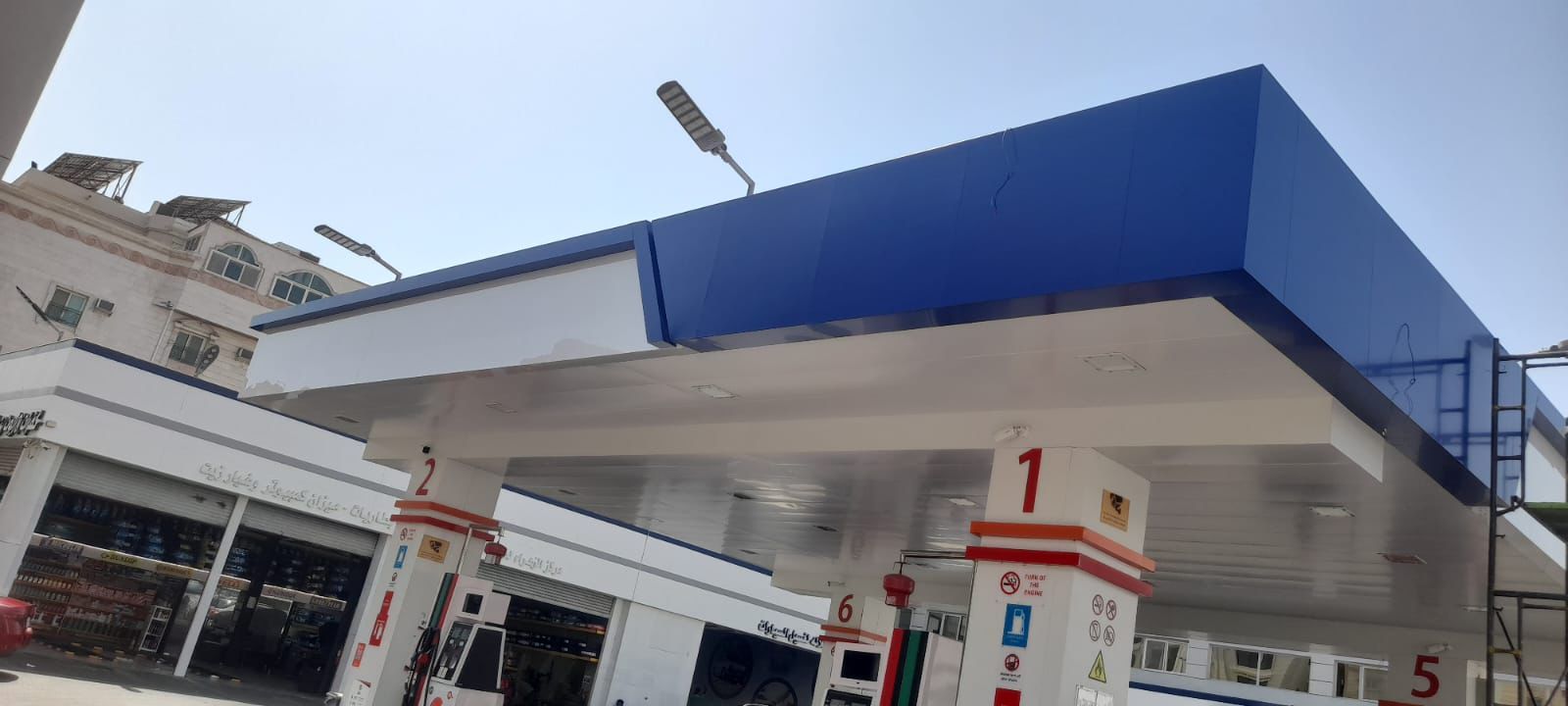
The requirements ask for a unified architectural style and consistent exterior finish colours across all station buildings, so the canopy fascia is never treated in isolation from the rest of the station.
The clear height under the canopy is at least 4.15 m over car lanes and 5.5 m over truck diesel lanes, which feeds directly into the fascia design and the positions of the logo and lighting.
The retail shop sign must be coordinated with the station's brand identity and integrated into its unified design, with strong white lighting inside the shop. In practice we order the shop fascia in the same production batch as the station fascias so colours and materials match.
Sign by sign: what the requirements say
The table below summarises the station's signage elements, the core requirement for each as stated in the 1445H requirements, and an execution note from our work in Jeddah.
| The sign | The core requirement | Execution note |
|---|---|---|
| Price tower | Structure at least 4.5 m, price panel from 3 m and no smaller than 1 m × 1.5 m, with the station name, services and fuel grades | Designed in the operator's identity with the display aperture and cabling prepared |
| Electronic price display | IP65 rated, English numerals in uniform sizes, one static price per product around the clock | Digit colours and heights from tables 4-1 and 4-2 by road speed |
| Entry and exit signs | Reflective, in Arabic and English, with painted or reflective arrows | Fitted at every entrance and exit with a night sight-line check |
| Warning signs | Bilingual, carrying the three mandatory phrases verbatim | On the pump columns and squarely in the driver's view |
| Wayfinding and emergency signs | Arabic and English per SBC-201, with emergency exits and assembly points | Includes the site map, the first-aid signs and the fuel shut-off labels |
| Canopy fascia | Colours unified with all station buildings, clear height 4.15 m for cars and 5.5 m for truck diesel | Installed in phases by pump island while the station trades |
| Retail shop sign | Coordinated with the brand identity and integrated into the station's unified design | Produced in the same batch as the station fascias |
How we execute one station or a network
We start with a survey of one representative station: canopy and columns, pumps, price tower, existing signs and power sources. We then lock the colours with the operator's brand manual, RAL codes for paint and vinyl codes for wraps, and order the material for all sites in one batch so the tenth station matches the first.
Installation is phased by pump island, with night shifts where needed and forecourt traffic managed with cones and barriers, so the station keeps selling throughout. For a multi-station rollout, a site-by-site, phase-by-phase schedule goes in front of the operator before work starts.
Compliance is not an end in itself: the operator also needs it for the Ministry of Energy's fuel-station qualification certificate, a free electronic service on the Taheel platform. Send us the number of stations and their locations, and we come back with a phased multi-station execution plan.